Animal Rights Reading Passage Kindness: A Practical Guide for Educators and Caregivers
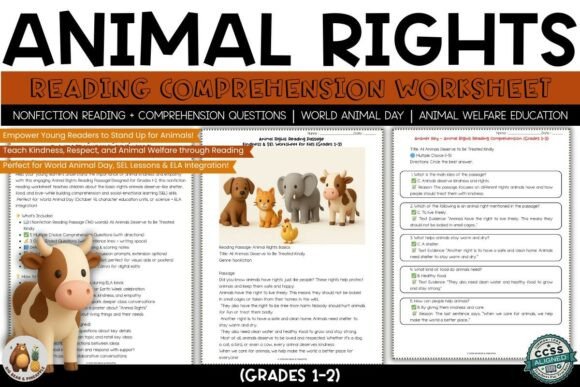
In the bustling world of early education, finding resources that seamlessly blend literacy with character development can be a challenge. The Animal Rights Reading Passage Kindness worksheet (WS0389) addresses this need directly by offering a concise, nonfiction text designed specifically for children in Grades 1 and 2. This resource is not just another page to fill; it is a structured tool that helps young learners grasp the fundamental concept that all living creatures deserve shelter, food, and love. For teachers, homeschooling parents, and educational content creators, understanding how to leverage this specific passage can transform a standard reading block into a meaningful lesson on empathy and social-emotional learning (SEL).
Understanding the Core Value of the Resource
The primary strength of the Animal Rights Reading Passage Kindness lies in its brevity and clarity. At approximately 140 words, the text is perfectly calibrated for first and second graders who are transitioning from learning to read to reading to learn. It avoids complex jargon while introducing serious concepts like animal welfare in an accessible way. Unlike abstract discussions about rights, which can feel distant to a six-year-old, this passage grounds the conversation in tangible needs: a warm place to sleep, nutritious food, and gentle treatment.
For educators managing tight schedules, the inclusion of five multiple-choice questions and three open-ended writing prompts provides immediate assessment tools. The detailed answer key, complete with reasoning notes, saves hours of preparation time. This efficiency allows adults to focus less on grading mechanics and more on facilitating the conversations that truly matter. When a child reads about an animal needing care, they are not just decoding words; they are building a neural pathway for compassion.
Integrating the Worksheet into Daily Lesson Plans
The versatility of this reading comprehension worksheet makes it suitable for various points in the academic calendar. While it is explicitly designed for World Animal Day on October 4th, its utility extends far beyond a single date. In a typical ELA (English Language Arts) block, teachers can use the passage as a morning work activity or a guided reading station. The short length ensures that even students who struggle with attention spans can complete the task without feeling overwhelmed.
Consider a scenario where a teacher is covering a unit on community helpers or habitats. Instead of sticking strictly to human roles or geographical facts, inserting the Animal Rights Reading Passage Kindness adds a layer of ethical consideration. Students can compare how humans provide for their own families versus how we should provide for animals. The open-ended questions encourage students to articulate their thoughts in full sentences, bridging the gap between silent reading and expressive writing. This dual focus supports both literacy standards and SEL goals simultaneously.
Real-World Applications for Homeschoolers and Tutors
Homeschooling parents often look for materials that cover multiple subjects at once to maximize limited teaching time. This worksheet serves as an excellent anchor for a "Science meets Social Studies" afternoon. A parent might start by reading the passage aloud together, discussing the vocabulary words like "shelter" and "welfare." Following the reading, the child can complete the multiple-choice section independently to check their understanding.
Tutors working with small groups can utilize the Animal Rights Reading Passage Kindness to spark peer-to-peer dialogue. By asking the open-ended questions, tutors can guide students to share personal experiences with pets or visits to zoos. This transforms a solitary reading exercise into a collaborative discussion about responsibility. For instance, a tutor might ask, "What would you do if you saw a stray cat outside?" allowing the students to apply the concepts from the text to real-life situations they might encounter in their neighborhoods.
Creative Extensions and Digital Adaptation
One of the most valuable features of this resource is its adaptability. The worksheet is ready to print on standard 8.5"x11" paper, making it ideal for physical classrooms. However, the digital-friendly format also allows creators to drop the file into design tools like Canva. Bloggers creating content for World Animal Day can extract the core message to write companion articles, while visual artists might use the themes to create coloring pages or posters.
Teachers looking to extend the lesson can pair the reading with an art project. After completing the comprehension questions, students might draw a picture of a safe home for an animal or write a letter to a local shelter. This multimodal approach reinforces the lesson through different learning styles. For entrepreneurs running educational supply stores, this type of high-quality, thematic content represents a reliable product that parents trust for its alignment with curriculum standards and moral development.
Strategic Considerations Before Use
While the Animal Rights Reading Passage Kindness is a robust tool, thoughtful implementation is key to maximizing its impact. Educators should consider the emotional maturity of their specific group of students. Discussing animal rights can sometimes bring up sensitive topics for children who have experienced pet loss or have strong feelings about animal cruelty. The teacher's guide included with the worksheet offers SEL discussion prompts that help navigate these emotions safely, ensuring the conversation remains constructive rather than distressing.
Additionally, users should evaluate how this resource fits into their broader curriculum goals. If the objective is purely to improve reading speed, this passage might be too short. However, if the goal is to develop critical thinking and empathy alongside literacy, it is an ideal fit. Parents and teachers should also prepare to listen actively during the open-ended responses. The true value often lies not in the correct answers on the bubble sheet, but in the unique perspectives children offer when asked to explain why kindness matters.
Building a Culture of Empathy Through Education
Ultimately, resources like the Animal Rights Reading Passage Kindness serve a purpose larger than test scores. They lay the groundwork for a generation that views itself as part of a wider community of living beings. Whether used in a public school classroom, a private tutoring session, or a home learning environment, this worksheet provides a structured yet flexible way to introduce complex ethical ideas.
By choosing materials that integrate factual reading with values-based learning, adults empower children to become compassionate citizens. The combination of clear text, targeted questions, and practical application ensures that the lesson sticks. As schools and families continue to prioritize social-emotional learning, having reliable, well-crafted tools like this becomes essential for fostering a kinder, more aware world.