Bus Line Art Vector Bundle: A Practical Evaluation for Designers
In the crowded landscape of digital assets, finding resources that balance aesthetic minimalism with functional versatility is a constant challenge. The Bus Line Art Vector Bundle addresses this specific need by offering a curated collection of high-quality vector illustrations centered on public and private transportation. For professionals working in branding, editorial design, or marketing within the transit sector, this bundle represents more than just a set of images; it is a toolkit for establishing visual consistency across complex projects. Unlike raster-based graphics that degrade upon scaling, these vector files maintain their integrity at any resolution, making them a reliable choice for everything from small social media icons to large-scale outdoor billboards.
The Core Value of Minimalist Transportation Graphics
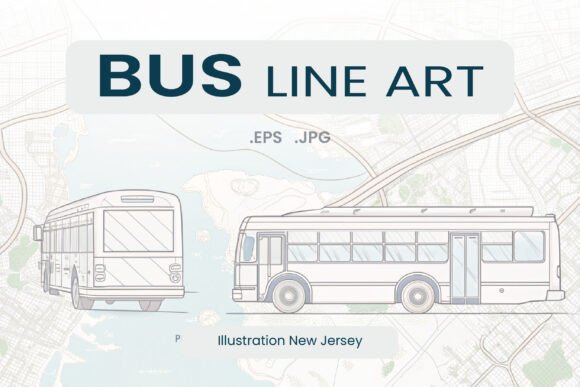
The primary strength of the Bus Line Art Vector Bundle lies in its adherence to a sleek, minimalist line art style. In modern graphic design, there is a distinct shift away from heavy shading and photorealism toward cleaner, more abstract representations. This trend is particularly evident in the transportation industry, where clarity and speed of recognition are paramount. The bundle capitalizes on this by stripping bus designs down to their essential geometric forms. The result is a set of illustrations that communicate the concept of "bus" instantly without visual clutter.
This approach offers significant practical value. When a designer needs to create an icon set for a mobile app or a series of wayfinding signs for a transit hub, detailed renderings can become distracting. The clean lines found in this collection ensure that the subject matter remains the focal point. Furthermore, the precision of the lines suggests a level of technical proficiency that translates well into professional deliverables. Whether the project involves a city bus navigating urban streets or a school bus serving educational routes, the stylistic uniformity ensures that all elements feel like part of a cohesive system rather than a random assortment of stock photos.
Variety Within Consistency
A common pitfall in many vector bundles is a lack of variety, forcing designers to stretch a single asset to fit multiple contexts. The Bus Line Art Vector Bundle avoids this limitation by including a diverse range of vehicle types. The collection features city buses, tour coaches, and school buses, each meticulously crafted to reflect the unique characteristics of its category while maintaining the overarching aesthetic language.
- City Buses: Designed with rectangular proportions and multiple windows, ideal for urban transit maps and municipal branding.
- Tour Buses: Featuring elongated bodies and distinctive rooflines, perfect for travel agencies and tourism campaigns.
- School Buses: Recognizable by their classic shape and color-coding potential, suitable for educational materials and safety campaigns.
This segmentation allows creatives to select the exact asset that matches their narrative without compromising the visual identity of the project. For a transportation company launching a new fleet, having access to these specific variations means they can create targeted marketing materials for different service lines without hiring an illustrator to draft each one from scratch.
Technical Performance and Workflow Integration
From a technical standpoint, the usability of the Bus Line Art Vector Bundle is a critical factor for adoption. Vector formats, typically delivered as SVG, EPS, or AI files, offer infinite scalability. This characteristic is indispensable for designers who must adapt assets for various media outputs. A logo designed for a business card must look as crisp when blown up for a billboard as it does on a website header. The mathematical precision of the paths in this bundle ensures that no pixelation occurs, regardless of the output size.
Furthermore, the structure of these files facilitates easier editing. Because the designs rely on clean lines, they are generally simpler to manipulate than complex, multi-layered illustrations. Designers can easily recolor strokes to match brand guidelines, adjust line weights to suit different print densities, or isolate specific components for animation. This flexibility reduces the time spent on post-production adjustments, allowing teams to move faster from concept to execution. For freelancers managing tight deadlines, this efficiency directly impacts profitability and client satisfaction.
Real-World Application Scenarios
To understand the true utility of this resource, it is helpful to visualize its application in real-world scenarios. Consider a startup developing a ride-sharing app focused on group transport. They require a visual identity that feels modern and trustworthy. Using the Bus Line Art Vector Bundle, they can create a suite of icons for their interface, ensuring that the bus symbol aligns perfectly with other UI elements. The minimalist style fits seamlessly into flat design systems, avoiding the clash that often occurs when mixing realistic textures with flat interfaces.
Another practical use case involves educational institutions. Schools and districts frequently produce newsletters, safety guides, and event posters. The inclusion of school bus illustrations in the bundle provides a ready-made solution for these communications. Instead of searching for generic clipart that may look outdated, educators can utilize these professional-grade vectors to create polished, authoritative documents. Similarly, tourism boards planning a campaign to promote regional connectivity can leverage the tour bus designs to illustrate itineraries and route maps, adding a layer of sophistication to their promotional materials.
Evaluating Long-Term Value and Limitations
While the Bus Line Art Vector Bundle offers substantial benefits, a balanced evaluation requires acknowledging its scope and limitations. The minimalist line art style, while versatile, is not a universal solution. Projects requiring photorealistic depictions of vehicles for architectural visualizations or automotive advertising would find this resource insufficient. The abstraction inherent in line art sacrifices detail for style, which is appropriate for branding and infographics but less so for technical documentation requiring precise mechanical details.
Additionally, the effectiveness of the bundle depends heavily on the designer's ability to integrate these assets into a broader visual strategy. While the vectors are high quality, they still require thoughtful composition and typography to achieve a professional final product. However, for the intended audience—graphic designers, marketers, and entrepreneurs—the bundle serves as a strong foundation. It eliminates the need to commission custom illustrations for standard transportation concepts, thereby reducing costs and accelerating project timelines.
Who Benefits Most?
The primary beneficiaries of the Bus Line Art Vector Bundle are those operating in sectors where transportation is a central theme. This includes:
- Graphic Design Agencies: Teams needing scalable assets for client branding packages.
- Transportation Companies: Businesses looking to refresh their visual identity with modern, clean aesthetics.
- Marketing Professionals: Creators developing campaigns for public transit, tourism, or logistics.
- Educators and Publishers: Individuals producing content related to civics, safety, or community services.
For these groups, the bundle offers a cost-effective way to access premium design resources. The long-term value extends beyond a single project; once purchased, these assets can be reused and adapted for future initiatives, providing a return on investment through repeated utilization.
Final Considerations for Implementation
Ultimately, the decision to incorporate the Bus Line Art Vector Bundle into a workflow should be based on specific project requirements and stylistic goals. If the objective is to create clean, professional, and impactful designs that communicate efficiently, this collection is a robust option. Its focus on precision and scalability aligns with the demands of modern digital and print media. By offering a range of bus types within a unified visual language, it empowers creators to build cohesive narratives around mobility and transit.
Designers should approach this resource as a strategic tool rather than a quick fix. The true power of the bundle emerges when these vectors are combined with strong typography, thoughtful color palettes, and purposeful layout. When used correctly, the Bus Line Art Vector Bundle elevates the quality of transportation-related projects, ensuring that the final output is not only visually appealing but also functionally effective. For professionals seeking to streamline their process without sacrificing quality, this collection stands out as a valuable addition to their creative library.