Fill in the Gaps Activity Worksheet: A Strategic Tool for Early Education
In the landscape of early childhood education and resource management, the Fill in the Gaps Activity Worksheet represents more than a simple printable. It is a structured mechanism designed to bridge the divide between passive consumption of language and active application. For educators, homeschooling parents, and curriculum developers, this resource offers a scalable method to assess comprehension, reinforce vocabulary, and build sentence structure without the friction often associated with traditional testing. When utilized with clear pedagogical intent, the Fill in the Gaps Activity Worksheet transforms from a generic activity into a precise instrument for measuring cognitive development and language acquisition.
The strategic value of this worksheet lies in its ability to isolate specific learning variables. By presenting a sentence with missing components, you force the learner to engage in critical thinking rather than rote memorization. They must analyze context clues, recall grammatical rules, and retrieve the appropriate vocabulary to complete the thought. This process mimics real-world communication gaps that adults navigate daily, making it an excellent tool for developing problem-solving skills alongside literacy. Whether used in a classroom setting for kindergarten through 4th grade or as part of a personalized homeschool curriculum, the resource demands active participation, ensuring that engagement is high and distractions are minimized.
Aligning Resources with Learning Objectives
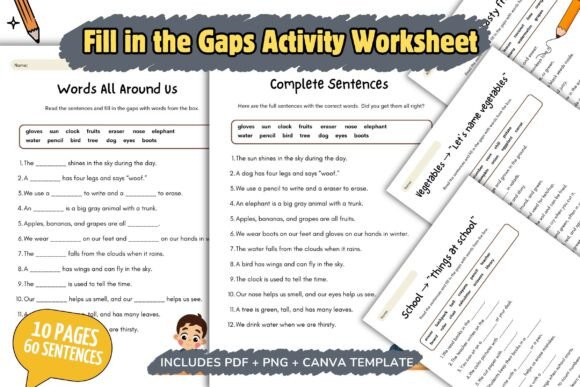
Before integrating the Fill in the Gaps Activity Worksheet into your educational plan, it is essential to define the specific outcomes you wish to achieve. Are you aiming to expand a child's vocabulary regarding specific categories like animals, fruits, and vegetables? Or is the goal to refine their understanding of syntax and sentence flow? The versatility of this digital download allows for targeted intervention. With five distinct activity pages covering themes such as school life, nature, and daily routines, you can align the content directly with your current instructional unit.
Strategic planning involves selecting the right difficulty level and topic mix. For instance, if a student struggles with noun-verb agreement, you might prioritize worksheets where the missing words are verbs within familiar contexts. Conversely, if the goal is vocabulary expansion, focusing on thematic lists like "Vegetables" or "Animals" ensures that new terms are introduced within a logical framework. The inclusion of 60 sentences across the five activity pages provides a robust dataset for tracking progress over time. This volume allows for consistent practice without overwhelming the learner, striking a balance between repetition and variety that is crucial for long-term retention.
Maximizing Versatility Through Digital and Print Formats
One of the most significant advantages of the Fill in the Gaps Activity Worksheet is its dual-format availability. The package includes 1 PDF file containing 10 pages total, alongside 10 individual PNG files. This flexibility supports diverse operational needs. In a physical classroom, the PDF format allows for quick printing of the 5 activity pages and the corresponding 5 answer key pages. The immediate availability of answer keys streamlines the assessment process, enabling teachers to provide rapid feedback—a critical component of effective learning cycles.
However, the true strategic edge comes from the digital integration capabilities. The 10 PNG files are optimized for digital learning environments, allowing students to complete activities on tablets or interactive whiteboards. This is particularly valuable for remote learning scenarios or hybrid models where physical handouts are impractical. Furthermore, the inclusion of an editable Canva template empowers educators to customize the content. You are not limited to the pre-set topics; you can modify the text to fit specific curriculum standards, incorporate brand-specific terminology for specialized programs, or adapt the difficulty to suit individual learner profiles. This customization capability ensures that the resource remains relevant and aligned with evolving educational goals.
Operational Efficiency in Curriculum Delivery
For busy professionals managing classrooms or homeschool schedules, time is a finite resource. The design of the Fill in the Gaps Activity Worksheet prioritizes operational efficiency. Each page contains 12 sentences, providing a concise yet comprehensive exercise that can be completed within a standard lesson block. This structure reduces preparation time, allowing educators to focus on instruction and interaction rather than creating materials from scratch. The clear separation of activity pages and answer keys further enhances workflow, minimizing the administrative burden of grading and self-correction.
When deploying these worksheets, consider the pacing of your curriculum. Using one page per day or week can create a consistent rhythm of practice. The variety of themes—ranging from school settings to food groups—prevents monotony and keeps learners motivated. Engagement is a key metric in educational success; if a student finds the material boring, the learning outcome diminishes regardless of the quality of the content. By rotating through the different topics included in the download, you maintain a dynamic learning environment that caters to varied interests while systematically building foundational skills.
Risks of Unstructured Implementation
Despite its benefits, the Fill in the Gaps Activity Worksheet carries risks if used without a clear strategy. Randomly assigning these activities without assessing prior knowledge or defining learning goals can lead to superficial engagement. Students may guess answers based on pattern recognition rather than genuine comprehension, resulting in a false sense of mastery. Additionally, relying solely on gap-fill exercises without supplementary reading or speaking activities can create an imbalanced skill set, neglecting other vital aspects of language development such as fluency and creative expression.
To mitigate these risks, always contextualize the activity. Before handing out the worksheet, discuss the theme and review relevant vocabulary. After completion, use the answer key not just for marking correct or incorrect responses, but as a springboard for discussion. Ask students why they chose a specific word or how changing that word would alter the meaning of the sentence. This approach elevates the worksheet from a mechanical task to a critical thinking exercise. Furthermore, ensure that the difficulty level matches the student's current abilities; tasks that are too easy foster complacency, while those that are too difficult can lead to frustration and disengagement.
Long-Term Value and Skill Acquisition
The ultimate measure of any educational resource is its contribution to long-term results. The Fill in the Gaps Activity Worksheet serves as a foundational building block for advanced literacy. By repeatedly practicing sentence construction and vocabulary retrieval, children develop the neural pathways necessary for fluent writing and reading comprehension. These skills are transferable, supporting academic performance across all subjects and fostering confidence in written communication.
From a decision-making perspective, investing in a resource that combines print and digital formats with customizable templates offers significant return on investment. It eliminates the need to purchase multiple disparate resources for different learning modalities. The ability to edit the content via Canva ensures that the material can grow with your program, adapting to new topics or changing educational standards. This scalability makes it a sustainable choice for both small-scale homeschooling operations and larger educational institutions.
Ultimately, the effectiveness of the Fill in the Gaps Activity Worksheet depends on the intentionality of its application. When used as part of a broader, well-planned educational strategy, it becomes a powerful tool for enhancing vocabulary, improving comprehension, and building writing confidence. It provides the structure needed for consistent practice while offering the flexibility to meet unique learner needs. By approaching this resource with a focus on outcomes, alignment with goals, and thoughtful implementation, educators and parents can maximize its potential to drive meaningful learning and lasting educational success.